Welcome to The Moral Compass project
We may not agree where it comes from but each of us has a moral compass to a greater or lesser degree.
Our moral compass may come from many places.
- Some people feel it comes from our upbringing and the example set by our parents or carers.
Lack of love, lack of good role models, lack of a happy and stimulating home, being sent away from home at a young age, abuse as a child - all these things can have a terrible impact later in life.
Some people live through it and become decent adults, some become fairly unpleasant and uncaring, others go completely off the rails - but, in all cases, the scars never go away.
- Some people think it comes from their religious beliefs.
- Some people think it is innate - part of being human.
- Some people figure it out for themselves.
We are not concerned about where you think your moral compass comes from - as long as you have one!
Most people:
- have a sense of empathy,
- have a moral compass,
- want to do well for themselves, their families and their fellow human beings,
- want to contribute positively to society,
- want to feel good about themselves.
There are a few who have none of the above, but they are fairly rare - thank goodness.
Unfortunately these few can be ruthless in politics and business when seeking power and personal wealth.
Have we all got one?
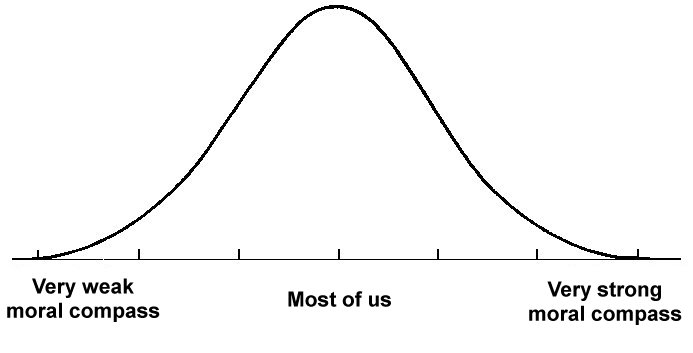
Like many things about being human, a moral compass may follow the normal distribution:
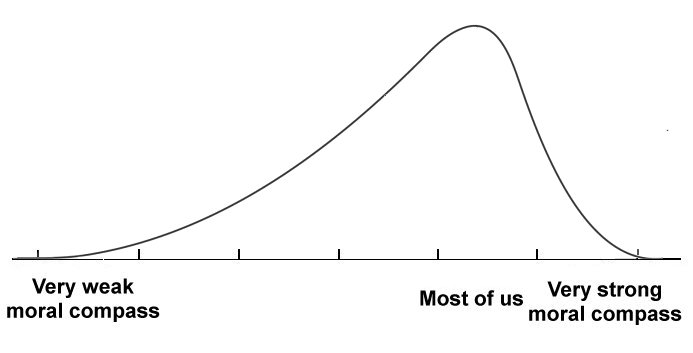
However, our life experience shows that most people have a pretty well developed moral compass - so a skewed distribution probably fits best leaving a few people with a very weak moral compass:
The mirror test
Our moral compass mirror provides the ultimate test - try looking into it as you brush your teeth at bedtime and decide which set of statements suits you best.