
This web site is under construction and contains details of products that will become available in 2024. Details of current DryFire products may be found at: www.dryfire.com
DLS v DPS: a comparison
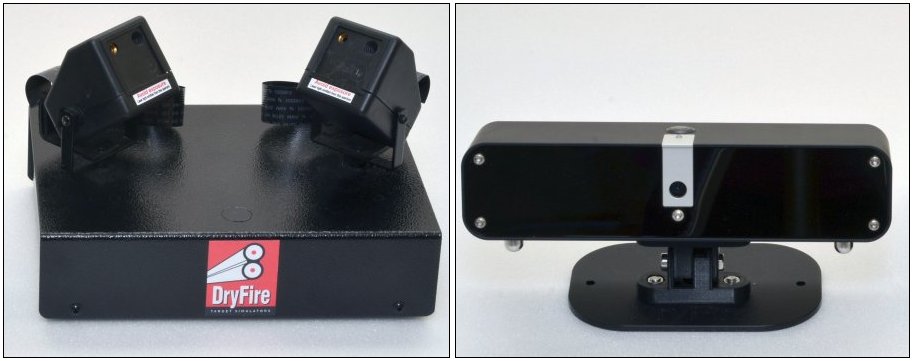
The DryFire Laser System (DLS) generates targets as moving laser dots on the wall in front of you. The dots do not change size or shape as the clay travels from trap to ground - they represent the leading edge of the clay.
The DryFire Projection System (DPS) generates targets as moving clay images on the wall/screen in front of you. The images change size and shape as the clay travels from trap to ground.
Both systems:
- show targets following exactly the same angular trajectories, at the same angular speeds, as real clays outdoors.
- provide detailed feedback of where your shot went in relation to the clay: above, below, in front, behind.
- can be mounted on any flat surface or on a tripod.
- require the same Standard Gun Assembly (SGA) fitted to your gun.
- have the same activation methods - including voice activation (call "Pull" to release targets).
DLS
- DLS does not require use of a PC data projector or screen.
- DLS does not generate a background image - some DryFire users paint a background on the wall and DryFire's US distributor supplies painted canvas backgrounds in 10', 14' and 18' lengths which can be seen in use here.
- DLS targets can make full use of the full wall width as well as side walls and the ceiling. The laser spot is visible from the trap to the ground. This is especially useful for very wide targets like crossers and Skeet Stand 4.
- DLS targets are bright and easy to follow - the laser dot is very visible!
- DLS can be used in a reasonably well lit room as long as there is no direct light, or reflections, falling anywhere along the path followed by the targets.
- Since it was introduced in 2001 DLS has been used by tens of thousands of shooters world-wide to improve their scores through intensive practice - it is tried and tested.
- DLS is mechanically more complex than DPS (and more expensive to manufacture and calibrate) - it uses four servo motors to move the heads that generate the targets and spot your shots.
- The results for each target (singles or doubles) are shown on your PC/laptop screen.
- The laser spot vanishes if you hit the target - it continues if you don't.
- DLS has a mains power supply and is connected to your PC/laptop via a USB cable.
DPS
- DPS requires a PC data projector (not supplied by Wordcraft) as well as a screen or painted wall.
- DPS displays a photo realistic background and photo realistic clay targets.
- DPS requires low background lighting so you can clearly see the images on the screen.
- DPS displays the part of a target's trajectory that fits within the boundaries of the screen, the wider the screen the more of the trajectory you will see. For most disciplines, trap in particular, the whole of the trajectory will appear on the screen.
DryFire allows you to define the angle at which you view the target. This is very useful for wider trajectories so you can adjust things for your hold point to appear on the screen and for you to take the target in front of you.
All clay targets should be taken within your comfort zone, you should not be shooting them as they leave the trap or chasing them into the ground!
- DPS is mechanically simpler than DLS (no moving parts) but electronically more complex - including three high speed processors and three digital cameras. (Most smartphones have one processor and two cameras!)
- The results for each target (singles or doubles) are shown on the screen in front of you.
- The clay "explodes" on the screen if you hit the target - it continues if you don't.
- DPS is wire-free. It is battery powered (rechargeable) and connected to your PC/laptop via WiiFi.
General comments
DPS is undoubtedly more realistic to look at - and certainly more fun with its exploding clays!
DPS will appeal to all members of the family, not just the dedicated shooters.
DPS is a great way to introduce new shooters to the sport - ideal for a club room!
DPS puts everything in front of you: background, targets and results, with no need to look back at the PC screen for feedback.
DLS, with no background displayed, is more suitable for the hard-core competitive shooter - it forces you to focus on the three most important things in clay shooting: the target, the target and the target - to quote George Digweed.
DLS can display very wide and very high targets - making use of side walls and ceiling if necessary.
DPS requires a PC projector and screen - DLS doesn't.
That's it - the choice is yours.