The passing of time
This is the history of one building (The Old Rectory) and one occupant (2025). Please click on the links shown like this for more information.
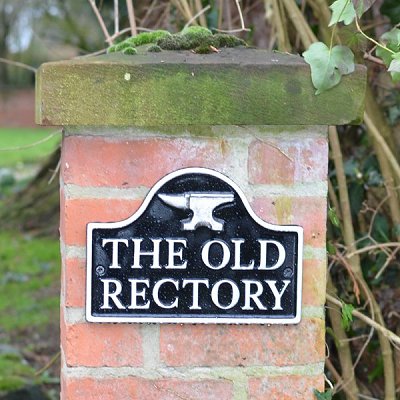
How many Old Rectory signs have a blacksmith's anvil at the top! (See below.)
In a place like Trusley it is hard to believe that things change over time - but they do - things rot, things fall down, the new becomes old and things have to be repaired or replaced. In a Conservation Area things change slower than in many places - even minor changes, like the felling of a rotting tree, require permission from the local authority (and quite right too!)
The building through time
The "rudely built" Rectory was erected in 1799 ("of flaming red brick") by the Rector, Francis Wilmot, and, like the land on which the next door church was built, it belonged to the estate. A survey in 1818 said: "the building consists of a house erected about 19 years ago in a slight and unworkmanlike manner, several of the floors and walls are already giving way and the pig sties are falling down." Major work in 1858/9 (cost £518) paid for by Rectors Col. E. T. Coke and W. Chandos, put the building "into a habitable state" and added the front extension and bay windows. More was done in 1869 (cost £118-10) by the Rector Mr Copestake.
Towards the end of the 19th century the church, Rectory and land were transferred to the Church of England and in 1944 the Rectory was sold to become The Old Rectory. The first freeholder was Mr R. W. Sutton, the Derbyshire County analyst, who, amongst other things, wrote a highly informative paper on "The Examination of Lard"
In 1982 The Old Rectory was purchased by a local builder with the intention of restoring it as his own home. Unfortunately, just after the restoration was complete, economic circumstances forced the builder to sell and Mike and Barbara Lake moved in during November, 1986.
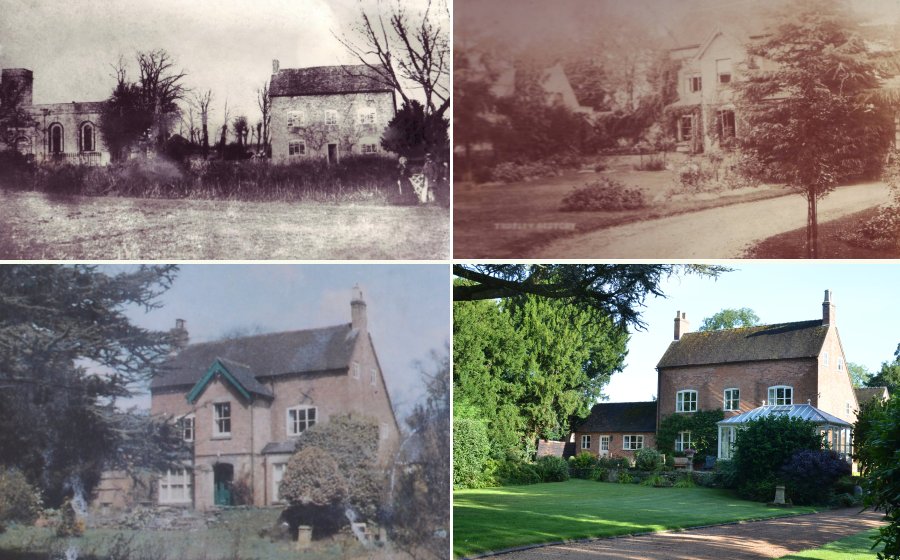
The photos below show The Old Rectory through time.
- Mid 19th century before work was done in 1858/9. Church clearly visible.
- 1914 with the Victorian additions. Church less visible because of tree growth. More photos here.
- 1982 still with the additions and showing steel rods added to hold the front and back walls together.
- 2024 after rebuilding and re-roofing in 1983/4 to remove support rods and Victorian additions. Outbuildings (on left) converted to utility room and boiler room in 1990 and conservatory added in 1994.
List of occupiers since it was built:
- 1799 Rev. Francis Wilmot (who built it)
- 1818 John Beer (tenant of the Glebe)
- 1858 Rev. Griffith Boynton
- 1859 Rev. William Chandos Pole (from the Chandos Poles at Radbourne Hall)
- 1866 Rev. John Copestake
- 1888 Rev. J. E. Phillips
- 1890 Rev. Wm. Hodges
- 1901 Rev. A. Johnson (whose photo album we have)
- 1933 Rev. A. Morgan Williams
- 1938 Rev. H. A. H. Brookshank
- 1944 Richard W, Sutton
- 1982 Jason G. Phillips (who did the rebuilding)
- 1986 Barbara and Mike Lake
The occupant through time
I (Mike) was born "over the shop" (literally) in Newent, Gloucestershire, where my father, Mark, was the local baker. He sourced his flour from nearby Cleeve Mill which had been the site of a water mill since Saxon times, and he became close to Mary, the daughter of John Lawrence, the miller. One shotgun marriage later and I appeared over the bakery - my sister, Sally, arrived two years later. In the 1990s a previously unknown half sister turned up on our doorstep in Trusley - the daughter from my father's previous marriage!
Cleeve Mill, and the cattle kept on the land around it, began my love of the countryside.
Please click the image to see Cleeve Mill on Streetview.

My grandfather Bill, Mark's father, had been the village blacksmith in Hartpury, 6 miles from Newent, and he was famous (locally!) for discovering a new type of apple - Lake's Kernel - a tree from a Lake's Kernel seed now grows in Hartpury churchyard. The history of smithing in the Lake family goes back even further because my great grandfather and great, great grandfather were also Hartpury's blacksmiths and farriers.
The Lakes have been in the Hartpury/Ashleworth area for centuries - some are still there! The excellent study: "The Squatter and Rural Settlement in the Georgian Age: Woolridge Common, Hartpury", shows that in 1763 John Lake ran an inn called The Rose & Crown which, by 1775, had been relocated and rebranded as The Crown. Prior to running the inn John had been an apprentice farrier six miles away in Gloucester - one of the long line of Lakes as blacksmiths. In 1780 John's son, Benjamin, built a cottage under a lease from the Dean and Chapter of Gloucester Cathedral and the photo below shows the cottage as it was in 1989.

Benjamin's cottage was the most northerly of a series of "encroachments" onto common land during the second half of the 18th century. Such encroachments ceased when the common land was enclosed at the beginning of the 19th century. The 18th century encroachments are shown below superimposed on the 1882 OS map
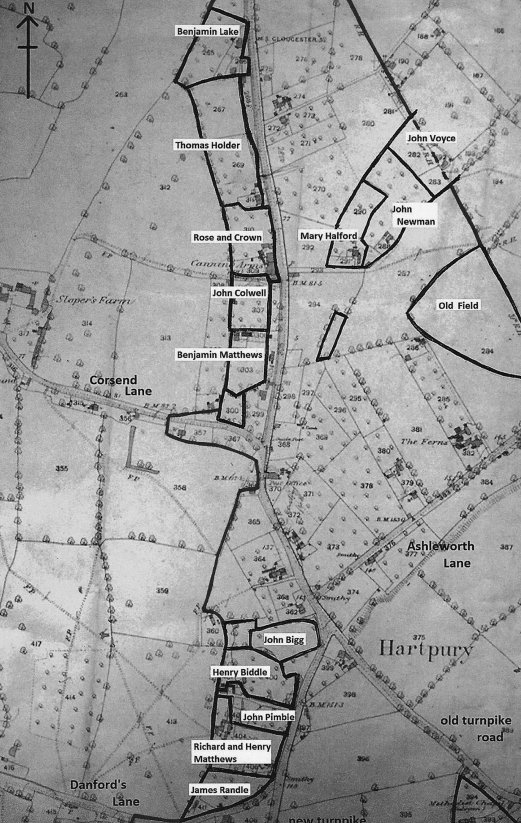
Similar encroachments may be seen along most of the lanes around Trusley with the cottages often side-on to the lane and narrow gardens running along the lane boundary.
Unfortunately time has not been kind to the Benjamin's cottage. In 2009 (left, below) the vernacular shape and layout of the windows was still respected as was the white-washed brick of the walls and chimney. By 2024 (right, below) a very unsympathetic "modernisation" had totally destroyed the vernacular shape and layout of the windows. had faced the chimney with stone cladding and covered the brickwork with render! No doubt Benjamin is turning in his grave!

By the time my father died in the 1970s we had completely lost contact with his side of the family - perhaps my mother's family had cut them off as a result of the circumstances surrounding my arrival (it was not a topic for family discussion!) - so we visited the Hartpury area to try to find one of his brothers. We succeeded! His brother, my uncle, lived in small cottage near the river Severn and when we stooped to enter the door it was like stepping into something from "Cider with Rosie" by Laurie Lee. On the bare scrubbed pine table was an ancient enamel plate with a hunk of bread and a piece of cheese. By the side, sticking into the table, was a sheath knife that my uncle had been using to cut the cheese. On looking round I saw, hanging above the door, a .22LR rifle with a silencer on the end of the barrel. It turned out that my uncle was the local poacher!
John Lawrence, my maternal grandfather, had managed to purchase two other farms in Herefordshire during the agricultural recession of the 1930s and he sold Cleeve Mill to purchase Cowfield Farm, 14 miles away near Tewkesbury. In 1953 my family moved to the associated Cowfield Mill (another medieval water mill - this time unused) and my father got a job at the MOD vehicle depot close by in Ashchurch.
Please click the image for the source of this 1941 record card.
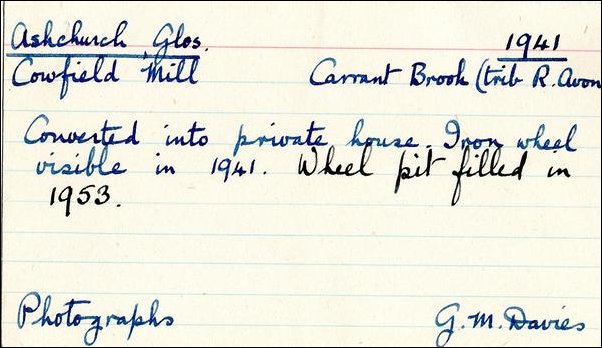
My grandfather was responsible for filling in the wheel pit.
The map below shows Cowfield Farm and Mill in relation to Tewkesbury and Ashchurch - please click the map (and maximise/rotate your screen) for a larger image.
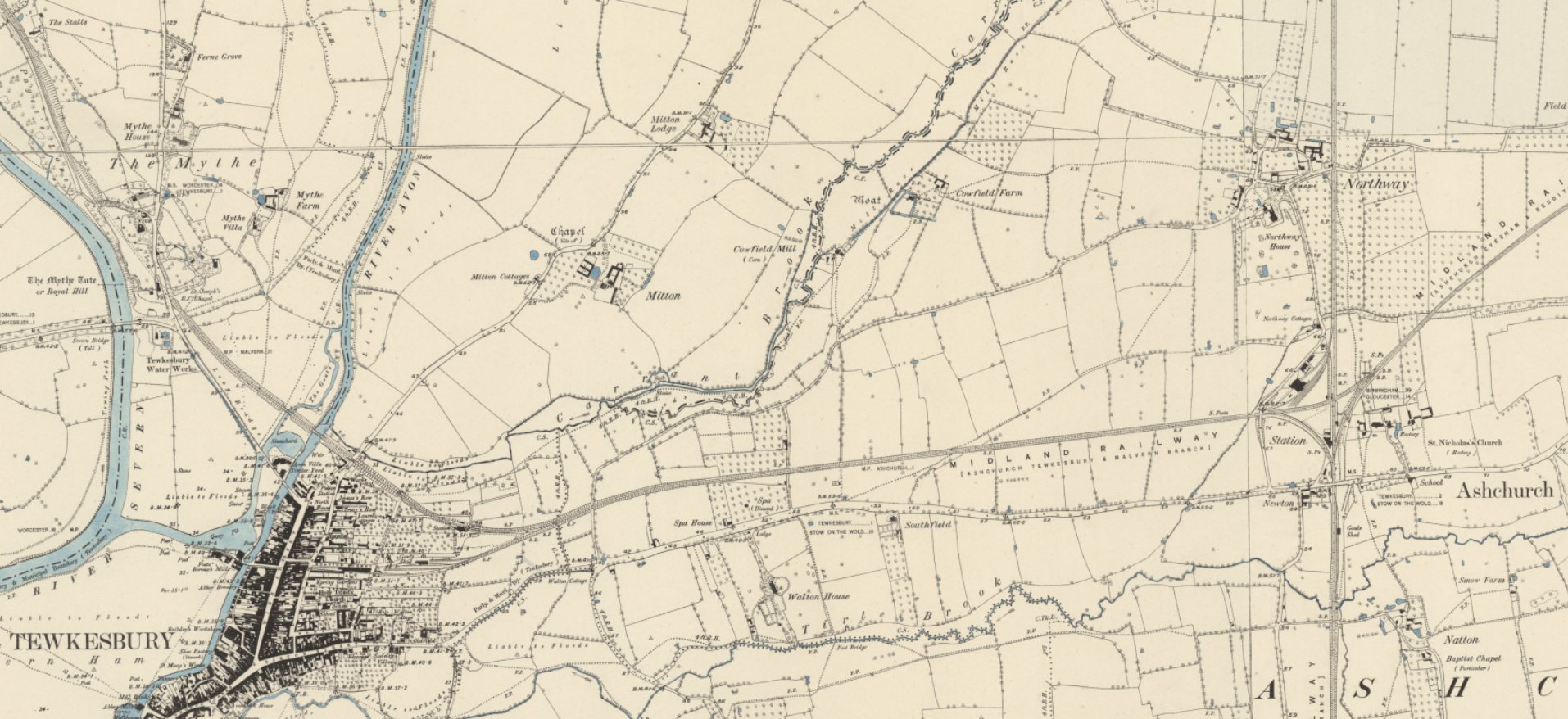
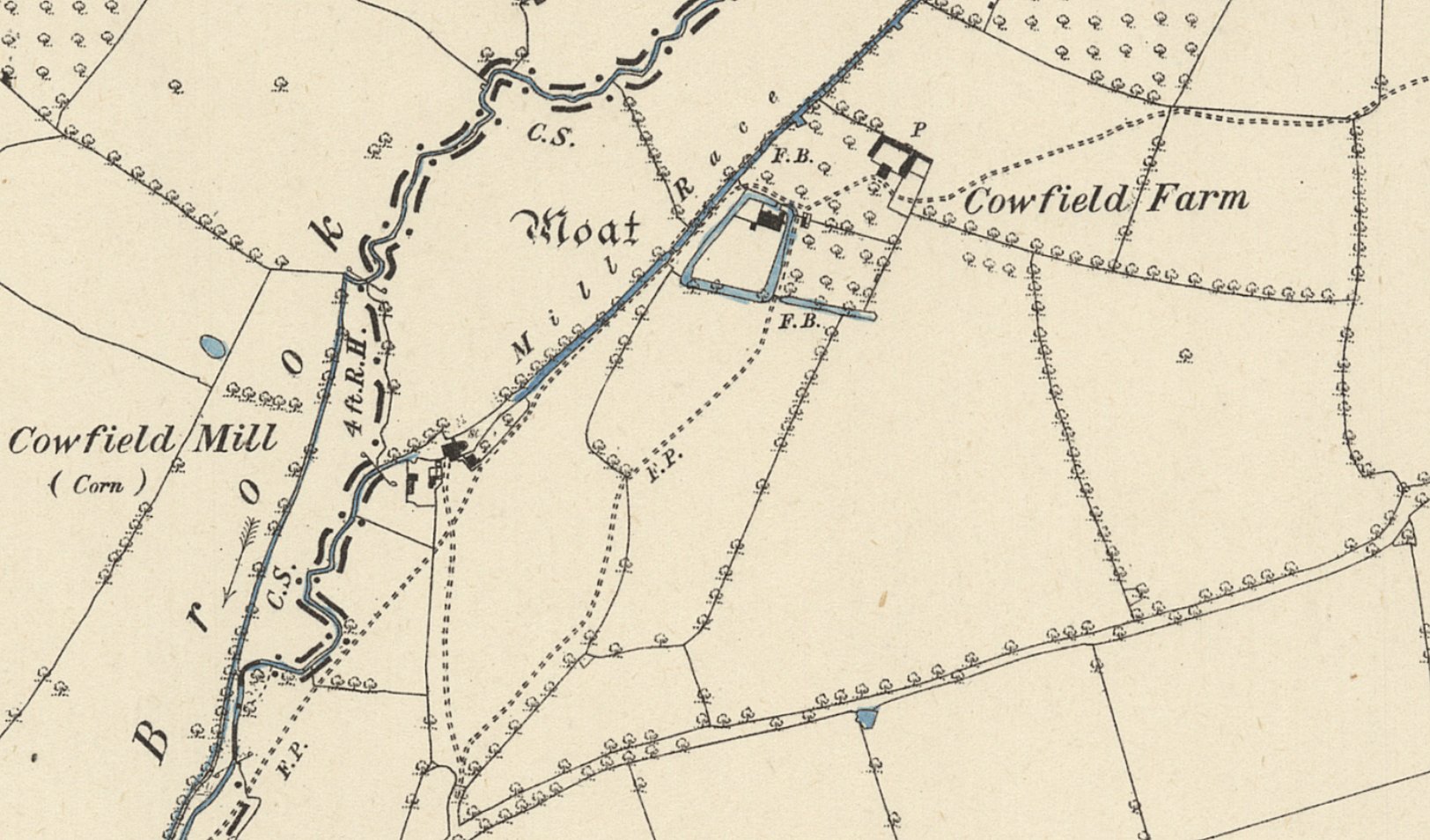
When young you often fail to recognise the importance of the environment around you - but two medieval water mills before the age of seven is pretty good going!
It all sounds romantic but it was far from it. No electricity (coal fire, paraffin Tilley lamps and a coal-fired stove), no mains water (we had a well) and no plumbing - the chemical toilet was in a shed half way down the garden!
When my grandfather died we moved up the lane where my mother acted as housekeeper for my uncle who ran the farm - mainly dairy cattle but also a large orchard of mature perry pear trees - the fruit of which we sold to Showerings to make Babycham! Soon afterwards electricity arrived at the farm and a bathroom was installed. At that time "electricity" meant "one socket per room if you were lucky" and various devices were run from three way adapters plugged into ceiling light sockets - running a light bulb, a valve radio and and an electric iron from a single light circuit held no fear (either that or ignorance was bliss!)
Cowfield Farm was brilliant: total freedom, out of the house after breakfast, back for dinner (lunch!), out again, back for tea (dinner!), helping to bring in the cows for milking, fetching milk down to the house afterwards, lying on my back looking at the stars and learning to drive on a Little Grey Fergie (Ferguson TE20). Again, it wasn't all perfect! My first introduction to alcohol was at the age of about twelve when I was found asleep under the tap of a 500 gallon barrel of perry in the cellar! Helping cut kale by hand to feed the cows, on a freezing February morning, was enough to put me off becoming a farmer!
My uncle sold the farm and, along with the matron of the local cottage hospital, retired to the South Coast. As was typical at that time, the three sons (my uncles) had inherited the farms and the two daughters, including my mother, had been left with almost nothing. We moved to a pre-fabricated council house (now reclad in brick) about a mile from the farm until I left for University and eventually made enough money to buy a flat for my mother overlooking the river Severn in Tewkesbury.
John Lawrence's family came from Wales (my mother's middle name was Myfanwy) and family oral history has it that my ancestors go back to the time before we ancient Britons were forced, by the Romans, into the great fastnesses of Wales. Over the centuries we slowly moved back eastwards, with a slight interruption as we fought Norman invaders, until my grandfather could afford to buy farms in Herefordshire and Gloucestershire. We still haven't moved far - my sister has recently moved back to Tewkesbury, I am still within a mile or two of the A38 and I still get a TV signal from Sutton Coldfield!
Personal identity
How we identify ourselves is important - it gives us roots!
I cringe when people talk about "patriotism" ("the last refuge of a scoundrel") and "pride in one's country" - you have no choice - you were born here. I assume people who claim to be "proud to be British" would be equally "proud to be French" or "proud to be Russian" if they were born in France or Russia. Nationality is not a choice (for most people).
I have no problem when people say they are proud of what they have done in life, proud of the contribution they have made to society - because those are things they have done themselves.
It gives me a warm glow to know where I come from - I am of peasant stock and the list of blacksmiths on my father's side of the family goes back a long way! Equally I know that on my mother's side the family goes back to the hills of Wales where they farmed before moving east into Herefordshire and Gloucestershire. I am firmly rooted in rural England - because it is what I know about, what I enjoy and where I feel comfortable.
Archaeology
Cowfield Mill and Cowfield Farm are now buried under an industrial estate - except for one thing - the pigsty which is now a listed monument!
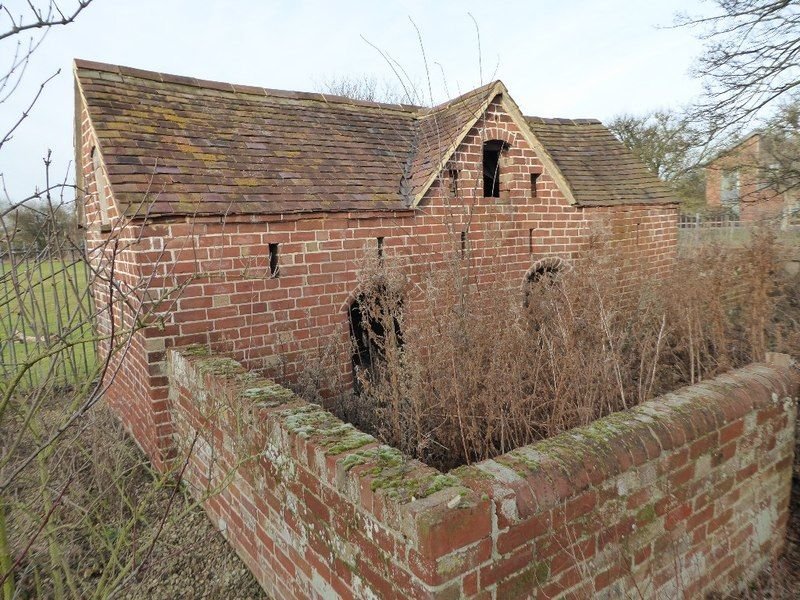
When I was about ten our dog ("Fido"!) had pups and my favourite was called BrownAle. My parents agreed that my cousins could have the pup but when they arrived to take it away I hid with it in the top of the pigsty. I was discovered and BrownAle left.
Before the Cowfield Farm site was covered in concrete an archeological survey was carried out. Please click the image below to read a copy.
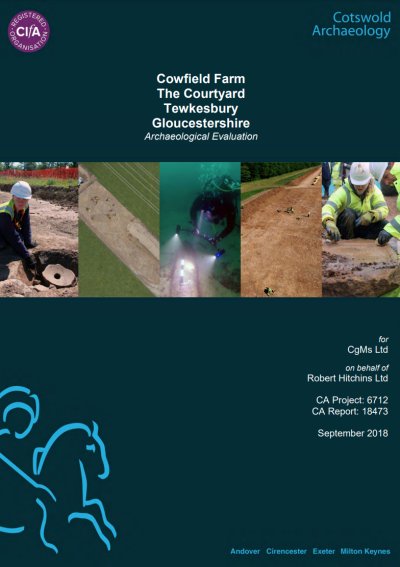
A more recent survey, before what was left of the farm house site was turned into a car park, explored the medieval moat - which my uncle filled in during the 1950s. Please click the image below to read the Cotswold Archeology report

The few
Looking back on my education I am 100% against single sex schools (coeducation is essential for emotional development, especially for boys!) and 100% against selection based on the ability to pass paper and pencil tests. At university I was friends with a very clever engineering student who had failed the 11 plus but who was given a second chance at 13. That was the exception, millions of children were (and still are in some backward corners of the country) labelled as second class because of the 11 plus.
When I left primary school in North Gloucestershire the 35 boys and 35 girls who did best at the 11 plus went on to the Grammar School (boys) or High School (girls), everyone else went to the Secondary Modern.. The only statistic that counted was how many chairs/desks were available.
Tewkesbury Grammar School dated from the 16th century when pupils were taught in a chapel attached to the abbey. A new building opened opposite the abbey in 1906 and finally, in 1952, the school moved to Southwick Park before closing forever with the opening of the newly built Tewkesbury School (comprehensive) in 1972. The Grammar school was always small (there were only 32 boys in 1862) and over the 20 years at Southwick Park, with single form entry, fewer than 700 pupils passed through its doors. Eton takes 120 pupils per year at a cost of £52,749 each, while Tewkesbury Grammar took 35 - for free! So, to be an Old Theocsbrian is to be one of the few - very different from the massed ranks of common or garden ex-public school pupils!
Our perry orchard got me into trouble when I took a few bottles into school during the Upper Fifth (year 11) end of year celebrations. I was caught and given a lecture by the head, George Brown who, for some reason had a sink in his office. I still remember him saying, as he poured the perry down the sink: "this is bad enough but never start on spirits". I remain a non-spirit drinker to this day - beer is another matter!
My year didn't do too badly - several of us went on to university (most of us being the first in our families to do so and with most of us on full grants) and we number two retired University professors and one retired World Bank advisor amongst our ranks - and me!
My post-University days are covered here.