The "Steel" side of "Coke-Steel"
Almost all the land in the parish of Trusley, and some outside the parish, is held by the Coke-Steel family.
The Coke family name crops up throughout Engish history: from Thomas Coke of Melbourne Hall, to John Coke who created the Pinxton Porcelain works; from Sir Edward Coke, 1st Baronet of Longford Hall, to "Coke of Holkham" - the great agricultural reformer who was:
"a firm believer in the right and moral obligation of a landowner to improve the quality of life of those living on his estates."
The various "Cokes" sometimes come from the same ancestral line while others appear to be unrelated.
There is a great deal known about the history of the Coke side of the Coke-Steel family, but very little known about the Steel side - so, with assistance from contacts in the Sheffield area, we have filled in some gaps.
Summary of the male line
- Henry Steel senior: 1832 - 1915
- Henry Steel junior: 1864 - 1920
- Ronald Steel: 1901 - 1963
- David Coke-Steel: 1944 -
- Edward ("Ed") Coke-Steel: 1983 -
Ed has two older sisters: Celia (1979 -) and Sophie (1982 -).
Henry Steel senior: 1832 - 1915
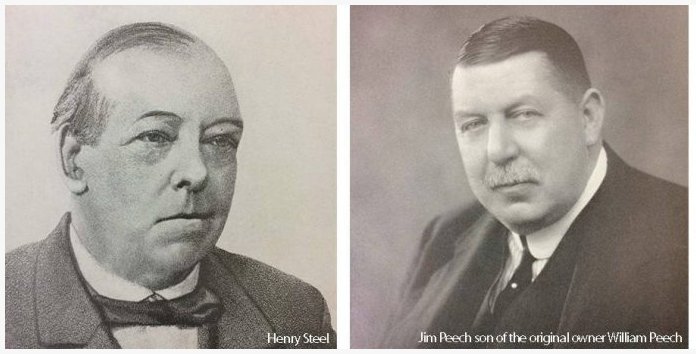
Henry Steel senior, son of William and Sarah Steel, started life as a fishmonger but took horse racing bets on the side and quickly realised he could make more money as a bookie than as a fishmonger. He, along with his friend William Peech, went on to make a fortune as bookmakers and is was rumored that Henry held the largest account at the Westminster bank in Sheffield. Amongst his clients were Lord Roseberry and the Prince of Wales, later Edward VII.
The story is told that, after Blue Gown won the Epsom Derby in 1868 at odds of 7/2, Henry strolled down to Tattersall's, the auctioneers, and deposited £9,000 (about £1.3 million today) to buy a horse.
Henry was famous at every racecourse in the country and by the 1870s was known as "the Leviathan - leader of the betting ring". On October 27th, 1877, Vanity Fair published a cartoon of Henry as "The Leviathan" and described him as the richest man ever to have made a fortune as a bookie.
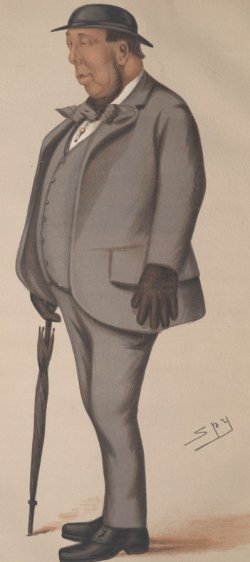
It is interesting that in 2025 gambling still seems to be the best way to make a fortune - as the bookie, not the punter - whether on the gee-gees or in the City of London! The fantasy dream of getting-rich-quick means that people never learn - a good reason for teaching statistics in schools!
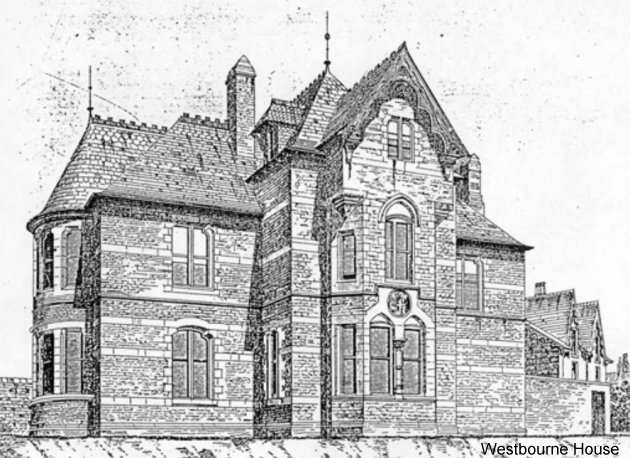
Henry and William Peech eventually moved to London where Henry bought the Archbishop of York's house, along with an extensive wine collection. He soon became bored with London and, leaving William living in Hornsey, returned to Sheffield in 1870 where he bought Westbourne House which is now a Grade II listed building converted into flats. The cost of building Westbourne in 1865 led its owner, William Stacy, a pianoforte dealer, into bankruptcy and this may have been when Henry acquired it.
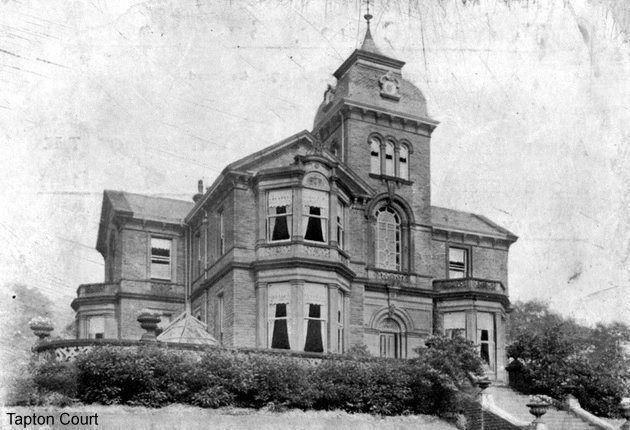
Some years later he moved to Tapton Court in Ranmoor. Tapton Court has now been converted to apartments and houses.
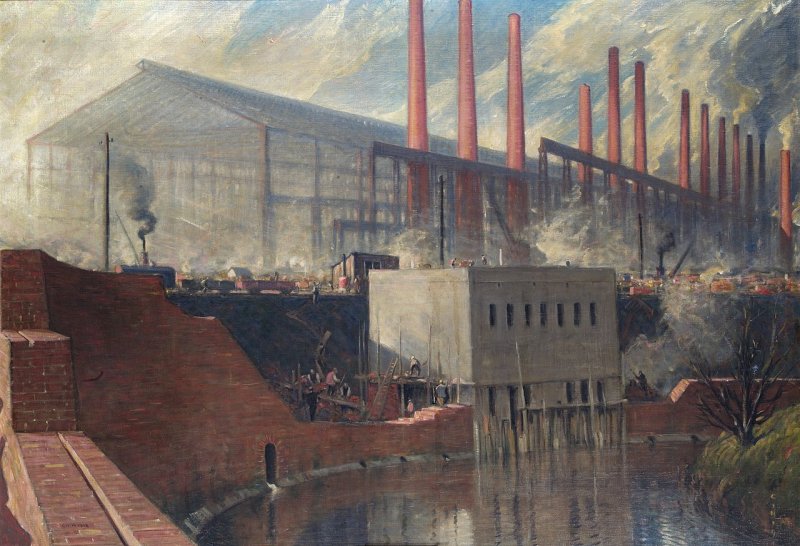
In 1875, the works of the Phoenix Bessemer Company had gone into liquidation with liabilities of £140,000. Henry, along with William Peech, Edward Tozer and Thomas Hampton, bought the works for £36,500, and turned it into a private company, "Steel, Peech and Tozer", with a capital of £70,000. After enlargements and improvements, the business became a huge success - at one time employing over 7,200 people.
The sketch below shows the Steel, Peech and Tozer works during World War 1.
Henry married William Peech's sister, Emma, and they had nine children:
- Clara Steel b. 1862
- Henry Steel b.1864
- William Steel b. 1865
- Sydney Steel b. 1870
- Emma Steel b. 1872
- Florence Steel b. 1875
- Ethel Steel b. 1878
- Eleanor Steel b. 1881
- Bernard Steel b 1883
When Henry senior died at Tapton Court in 1915, he left £652,418 in his will - around £85 million today.
Henry Steel junior: 1864 - 1920
Henry Steel junior was the son of Henry senior and William Peech's sister, Emma. On the death of Henry senior he took over as Chairman of Steel, Peech and Tozer and was instrumental in bringing together a number of English steel firms to form the United Steel Companies in 1918.
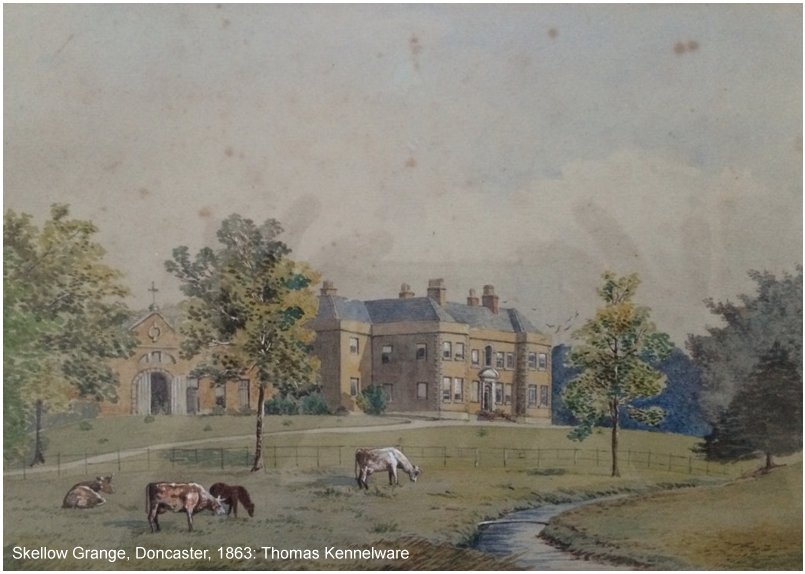
Henry junior was educated in Brussels and London University and, according to the 1911 census, was living at Skellow Grange near Doncaster - we think this is the current location and this is its history. Henry junior died in a London hotel in 1920 as a result of a seizure.
Henry junior's son, Gerald, took over as Chairman of Steel, Peech and Tozer when his father died.
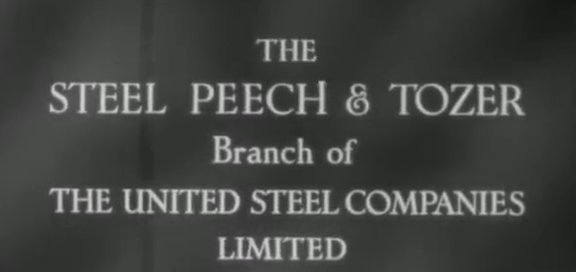
The film below was made in 1960 when Steel, Peech and Tozer was part of United Steel Companies Ltd.
Interesting fact: United Steel Structures, part of United Steel Companies, built the Jodrell Bank radio telescope.
Click the image below to watch a film about the Steel Peech & Tozer works.
Ronald Steel: 1901 - 1963
Ronald Steel was the son of Henry junior who married Maggie Ulyat.
On his death in 1932, William Steel, brother of Henry junior, left "large bequests to Beatrice Allea Bradbury, his niece Eileen and the residue to his nephews: Wilfred, Gerald and Ronald Steel". We know that Gerald went to Charterhouse school in Surrey and then on to Oriel Collage Oxford before eventually becoming Managing Director of The United Steel Companies before his death in 1957.
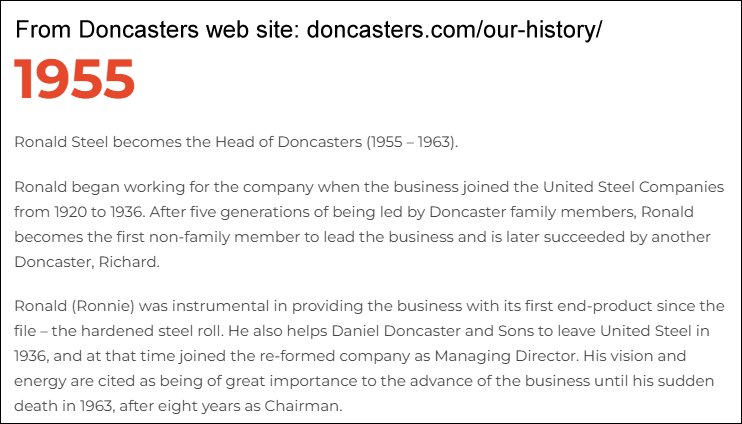
We don't know where Ronald was educated but he joined Daniel Doncaster & Sons, forgemasters, before it left the United Steel Company to go its own way in 1936. He went on to became Chairman in 1955.
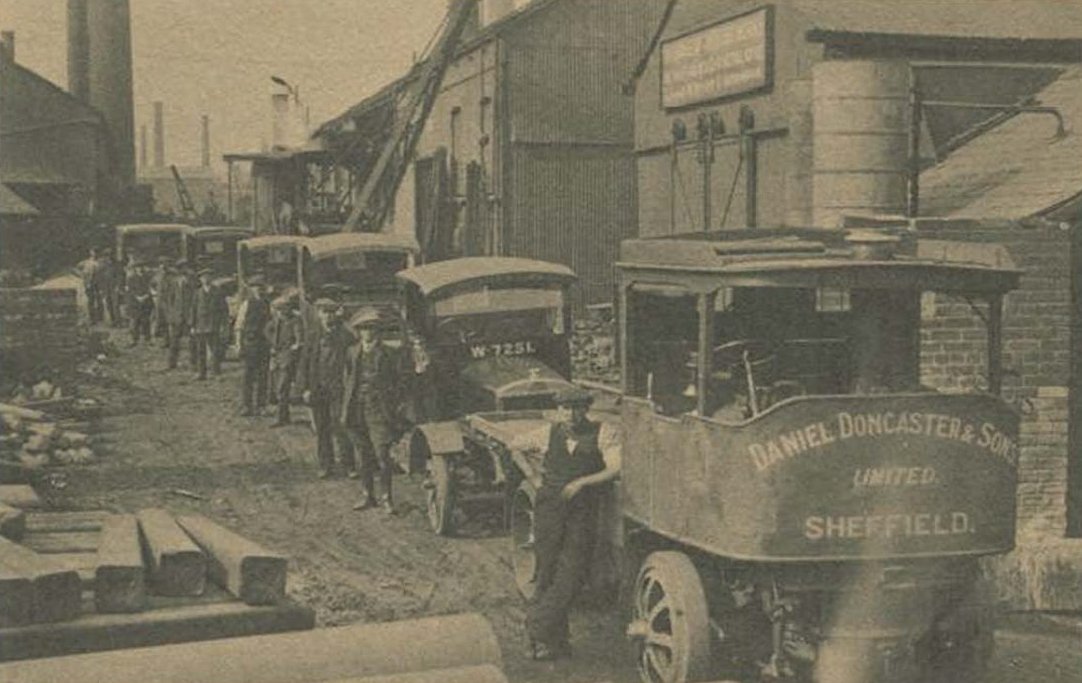
Doncasters delivery lorries in the 1920s - the one in the foreground is steam powered!
By the late 1930s Ronald was living at Wilsic Hall near Doncaster - now a special school called "The Paddocks". On the 4th June 1940 at Christ Church, Victoria Road, Kensington, London, he married Frances Helen Coke, elder daughter of Brigadier-General D'Ewes Coke of Trusley Manor. The family name was changed from Steel to Coke-Steel in 1945 and the family still maintains a house in Chelsea.
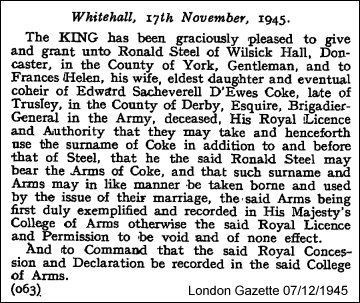
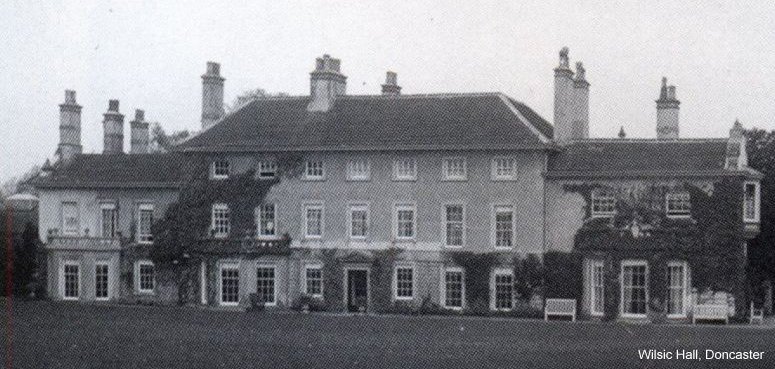
Francis and Ronald had two children, David born in 1944 and Julia born in 1948. Julia was christened at Wadworth just north of Wilsic so it is likely the family was living there at the time.
David took over the running of Trusley Estate following the death of his father (died 1963) and mother (died 1993).
In 1969, in Trusley church, Julia married Richard Meredith Swann, son of the biologist Michael Meredith Swann whose portrait is in the National Portrait Gasllery. Julia and Richard's son, Dr Robert Swann, is an engineer and business angel in Cambridge.