Klingon Alarm
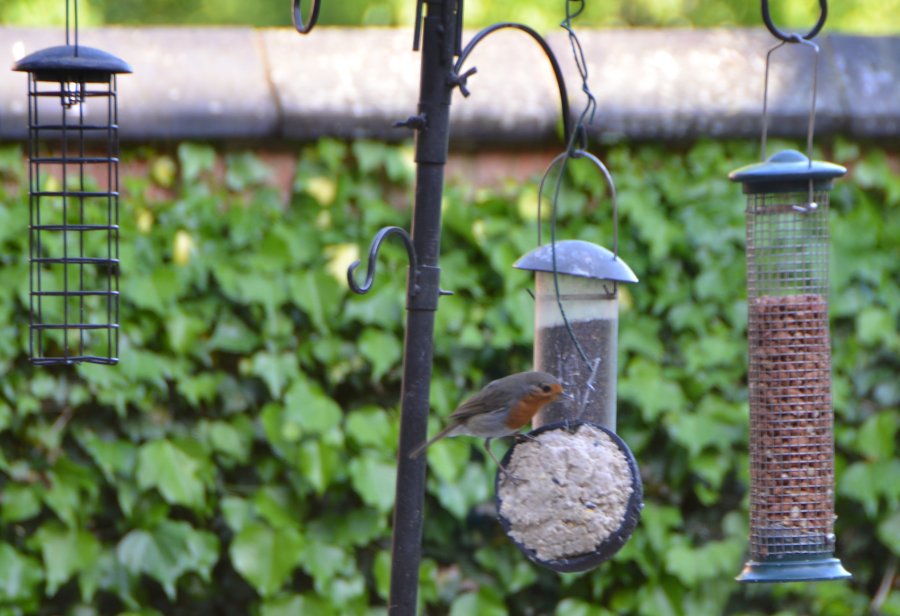
Each year millions of us spend a small fortune doing our best to help the local wildlife and this is the sort of image that warms our hearts - a robin enjoying a home-made fat ball in a coconut shell.
However ...
At certain times of the year we can be swamped by raiding parties of pesky squirrels or jackdaws.
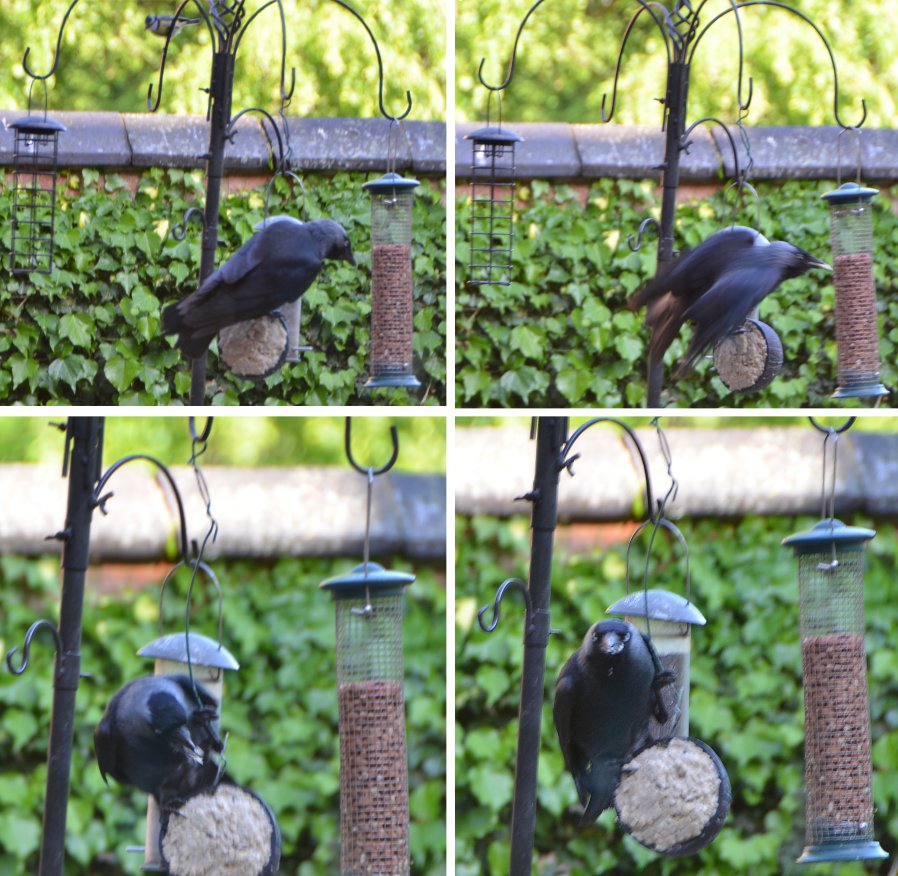
Jackdaws are extremely bright and they work as team - a scout close by keeps an eye out for opportunities and for human activity. If the coast is clear, the rest of the gang arrive to clean up under the bird table.
The correct name for a group of jackdaws is a "clattering", which is very appropriate given how noisy they are when chatting to one another.

Over time, jackdaws learn the art of clinging on so one will raid the food while the others wait underneath to clean up. Pigeons are OK - they haven't learnt how to cling on!
These jackdaws have already emptied the fat ball holder on the left and have turned their attention to the peanuts and fat mix in the coconut shell.
How do we give small birds a chance?
There are bird feeders that have a double layer of protection - an outer layer which allows small birds in but keeps large birds, and squirrels, out. These work - in theory - though we have seen squirrels force the external wires apart and we have seen jackdaws managing to reach right it! Never underestimate hungry wildlife!
There are devices which detect movement and then produce an ultrasonic sound above the range of human hearing. This is the principle on which mouse and cat scarers are supposed to work but there are three possible problems:
- Humans can hear the sound made by some devices - and it is very annoying! The younger you are, the more likely you are to hear the sound because human response to high frequencies drops off with age.
- Birds get used to them!
- Anything that makes a noise, or flashes a bright light, will upset your neighbours - ask anyone who has to put up with an annoying burglar alarm that uses a bright strobe while announcing "Warning: you are being recorded".
The Klingon Alarm (or "Cling-on Alarm")
The Klingon Alarm relies on unpredictable and random movement to frighten off unwanted visitors - think of it as a programmable jack-in-the-box.

Jackdaws, crows and magpies are very sensitive animals - they will flap off at the slightest sound or movement and they will stay away until they are absolutely sure the coast is clear. Small birds are more tolerant and will usually fly off a short distance and return very quickly.
Features
- Battery operated for outdoor use.
- Rain sensor to prevent operation during rain.
- Rechargeable from a PC/laptop USB port or from a USB charger.
- Programmed using a free smartphone app. (Prototype programmed from PC over USB.)
- Random popup action to scare squirrels and birds. The popup also generates a small amount of noise during movement.
- Any image may be fixed to the popup plate, e.g. a hawk profile.
- Universal fixing point on the back for attaching fitments for bird feeder poles or for ground spikes.
Among the variables that can be changed during programming are:
- The time(s) between which the system can operate. Multiple activation times may be set.
It is possible to leave a "window" (e.g. between 10:00am and 11:00am) when the system will not operate - perhaps to allow birds like woodpeckers to use the feeder.
- The minimum and maximum times between alarms.
- The minimum and maximum times the plate should be exposed.
- The minimum and maximum amount of plate exposure
- Speed of popup - between slow and fast.
For example:
- Operating between 06:00 and 10:00 and between 11:00 and 20:00.
- 1 minute minimum between alarms and 3 minutes maximum.
- 2 seconds minimum exposure and 10 seconds maximum.
- 20% minimum exposure, 100% maximum.
The Klingon Alarm will select random values between the minimums and maximums - and it is this unpredictability that prevents squirrels and birds becoming used to it.
The Alarm may be free standing, attached to a bird feeder pole or pushed into the ground using suitable adapters. Moving the alarm every few days increases the unpredictability.